Portage County Property Valuation determines how real estate is assessed for taxation and how much owners contribute to local services. The county assessor estimates market value using a structured process that reviews property size, location, condition, improvements, and comparable sales. From this estimate, an assessed value is calculated and used to apply the local mill rate for tax purposes. Increases or decreases in valuation directly affect tax obligations. This standardized system promotes fairness across residential, commercial, and agricultural properties while ensuring transparency and consistent revenue to support community services throughout Portage County.
Portage County Property Valuation also defines the county’s overall tax base, which funds schools, public safety, infrastructure, and essential services. The tax base equals the total assessed value of all taxable properties. Local governments set budgets and apply tax rates accordingly. Assessed value may differ from market value due to state-mandated ratios rather than full sale prices. Property owners can review notices and appeal discrepancies if needed. Regular reassessments keep records aligned with market trends, ensuring fair tax distribution and maintaining stable funding for public programs and long-term community development.
About the Portage County Auditor’s Office
Portage County Auditor’s Office manages property valuation in Ohio and holds legal authority to assess real estate for taxation. The office determines property values, maintains the county tax base, and preserves public property records for review. Under state law, the county auditor must appraise all taxable real property to ensure uniform assessments across residential, commercial, agricultural, and industrial classes. By applying consistent valuation standards, the office promotes fair and equitable taxation for property owners.
Legal Authority to Assess Property
Under Ohio law, the county auditor acts as the chief assessing officer. The office conducts sexennial reappraisals every six years and triennial updates in between. These cycles keep assessed values aligned with current real estate market conditions. These methods help determine accurate assessed value, which forms the basis for property tax calculations. The auditor follows state-mandated appraisal methods, including:
- Sales comparison approach
- Cost approach for new construction
- Income approach for rental and commercial property
Responsibilities in the Appraisal Process
The office updates records when properties are improved, newly constructed, or transferred through sale. Staff members analyze market trends to maintain equitable values across neighborhoods. Property owners receive valuation notices during reappraisal cycles. If concerns arise, they may file a complaint with the Board of Revision. This appeals process supports fairness and due process. The Portage County Auditor Property Valuation process involves detailed property review and data analysis. Appraisers examine property characteristics such as:
- Square footage
- Construction type
- Age and condition
- Land size and location
- Recent comparable sales
Maintaining the County Tax Base
The auditor plays a central role in maintaining the county tax base. The tax base equals the total assessed value of all taxable property in Portage County. By keeping assessments accurate, the Auditor’s Office supports stable funding for these services. Balanced valuations distribute the tax burden fairly across property owners. Local governments depend on this value to fund:
- Public schools
- Road and bridge maintenance
- Police and fire protection
- Public health services
- Libraries and community programs
Public Records and Transparency
Transparency remains a key function of the Portage County Auditor’s Office. The office maintains detailed property records that are open to the public. Residents can search parcel data, ownership history, sales information, and tax details through online databases. Open records promote accountability and trust. Property owners can review their assessed value, verify property details, and monitor changes over time. This public access strengthens confidence in the property valuation system and supports informed decision-making within Portage County.
How to Search Portage County Property Valuation Records
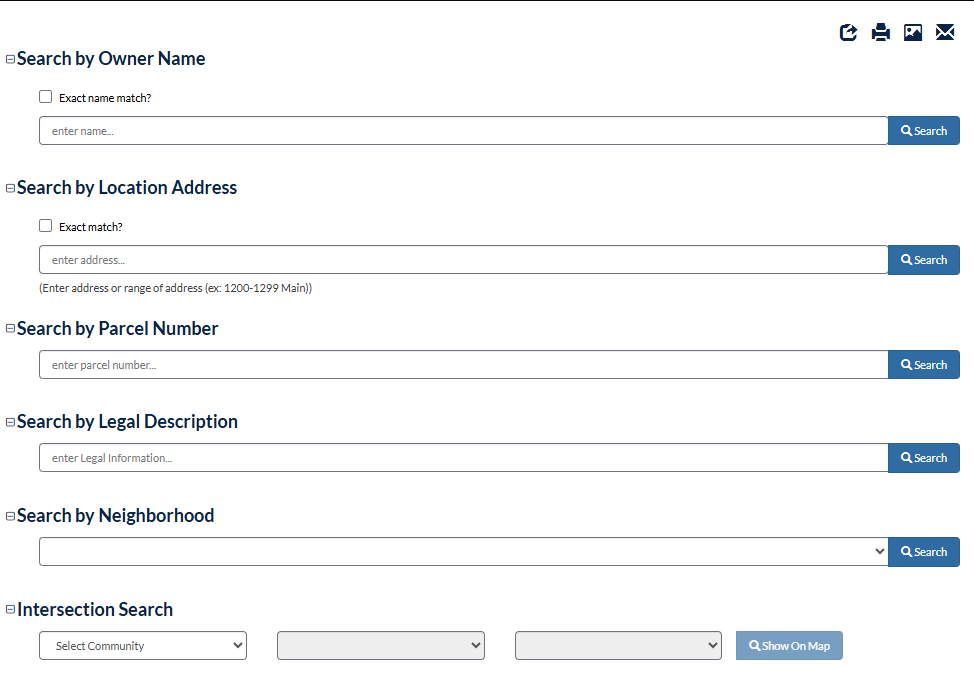
The online property search system allows users to perform an owner name search, parcel ID lookup, address search, and GIS parcel viewer search to retrieve detailed property records, assessed value data, and tax information. The Portage County Auditor’s Office maintains this public database to provide transparent access to property ownership records and valuation details. The tool supports buyers, sellers, lenders, real estate agents, attorneys, and property owners who need verified tax and assessment data.
Official URL: https://www.co.portage.oh.us/auditor
Visit the Official Website
- Open your web browser.
- Enter the official website URL: https://www.co.portage.oh.us/auditor
- Click on Property Search or Real Estate Search from the Auditor section.
- The property database Portage County search page will load.
Choose Your Search Method
The system offers multiple search options:
- Owner Name Search
- Parcel ID Lookup
- Address Lookup Tool
- GIS Parcel Viewer
Search by Owner Name
How to Use It:
- Select Owner Name Search.
- Enter the owner’s last name first.
- You may enter a full name or partial spelling.
- Click Search.
What You’ll See:
- Parcel number
- Property address
- Owner name
- Property classification
Search by Parcel Number
A tax parcel number search connects directly to one property record. No duplicate results appear.
Where to Find Parcel ID:
- Property tax bill
- Recorded deed
- Closing paperwork
- Assessment notice
How to Enter It:
- Select Parcel Number Search.
- Enter the parcel ID exactly as printed.
- Include dashes if shown.
- Click Search.
Search by Property Address
How to Enter Address Correctly:
- Type the street number first.
- Enter street name without punctuation.
- Use standard abbreviations (St, Rd, Ave).
- Add unit number only if required.
Using the GIS Mapping
The GIS parcel viewer allows map-based searching.
Steps:
- Click GIS Map or Parcel Map Viewer.
- Zoom into the area manually.
- Click directly on a parcel boundary.
- A property data window will appear.
Features Available:
- Interactive parcel boundaries
- Property dimensions
- Zoning layers
- School district boundaries
- Sales history overlays
- Tax district information
Assessed Value vs. Market Value
Assessed value is the taxable value assigned by the county for property tax purposes. A market value assessment reflects the fair market price a property would likely sell for under normal conditions. Many property owners confuse these two numbers, yet they serve different purposes. One estimates what buyers would pay. The other determines how much tax the property owner owes.
What Is a Market Value Assessment?
A market value assessment estimates the fair market price of a property in an open and competitive market and is often reviewed during a property transfer to ensure accurate valuation. This value reflects what a willing buyer would pay and a willing seller would accept. The Portage County Auditor follows accepted property appraisal standards to keep valuations consistent. Market value can change yearly based on housing demand, interest rates, and economic conditions. For example, if similar homes in a neighborhood sell for $300,000, that figure helps shape the market value assessment for comparable properties.
County appraisers analyze:
- Recent comparable sales
- Property size and condition
- Location and neighborhood trends
- Improvements and renovations
- Local real estate market activity
What Is Assessed Value?
The assessed value is the portion of market value used to calculate property taxes. It often represents a percentage of the market value rather than the full amount. Many states require a fixed assessment ratio. For instance, if the state mandates a 35% ratio and the market value is $300,000: $300,000 × 35% = $105,000 assessed value
This assessed value becomes the property’s taxable value. Assessment ratios help create uniform taxation across counties. Without a standardized percentage, tax bills could vary widely between similar properties.
Equalization Factors
Equalization factors adjust property values to maintain fairness across districts. When property markets grow unevenly, some areas may appreciate faster than others. This step keeps the tax burden evenly distributed. Equalization protects taxpayers from systematic overvaluation or undervaluation in certain areas. A state equalization process:
- Reviews total property values within each district
- Compares assessments to actual sale prices
- Adjusts values when needed
How Assessed Value Affects Property Taxes
Property taxes are calculated using this basic formula: Assessed Value × Local Tax Rate = Annual Property Tax
If assessed value rises, property taxes usually increase. If it decreases, taxes may decline, assuming tax rates remain stable. Accurate assessments support fairness and stable funding. Local governments rely on assessed values to fund:
- Public schools
- Emergency services
- Infrastructure maintenance
- Public health programs
Assessed Value vs. Market Value Comparison
| Term | Meaning | Used For |
|---|---|---|
| Market Value Assessment | Estimated fair market price based on sales data and appraisal methods | Reflects what a property could sell for |
| Assessed Value | Percentage of market value set by law | Calculates property taxes |
| Taxable Value | Value after exemptions are applied | Determines final tax bill |
The Property Assessment Method in Portage County
The property assessment method in Portage County uses a structured mass appraisal system to value large groups of properties at once. This method applies standardized appraisal models, market data, and classification rules to determine fair and consistent assessed values for taxation. County assessors must value thousands of parcels efficiently and accurately. Instead of evaluating each property as if it were for private sale, the county applies uniform models supported by verified sales data, construction records, and property characteristics.
What Is the Mass Appraisal System?
A mass appraisal system is a statistical valuation process used by local governments to assess many properties at the same time. It relies on market modeling rather than individual negotiation-based pricing. This system groups similar properties by type, location, and market behavior. Assessors analyze recent sales trends within each group to create valuation models. These models apply to all comparable parcels.
Mass appraisal promotes:
- Uniform taxation
- Equal treatment across neighborhoods
- Efficient reassessment cycles
- Compliance with state property appraisal standards
Data Collection Methods
Accurate assessments depend on reliable data. Portage County gathers property information from multiple sources. Appraisers record structural details such as square footage, age, construction type, number of stories, and improvements. Market sales data plays a key role in calibrating values. Regular updates help maintain alignment with current market value assessment trends.
Common data collection methods include:
- Field inspections during reappraisal cycles
- Building permit records
- Deed transfers and sales filings
- Aerial imagery and GIS parcel mapping
- Property owner questionnaires
Property Classification
Every parcel falls into a classification category. Classification determines how the property is valued within the mass appraisal system. Each class follows different valuation models. For example, farmland often receives agricultural use valuation based on productivity rather than development potential. Correct classification ensures consistent taxable value calculations.
Main property classes:
- Residential (single-family, condos, duplexes)
- Commercial
- Agricultural (farmland, barns, rural acreage)
- Vacant land
Comparable Sales Analysis
Comparable sales analysis forms the backbone of residential valuation. Assessors study recent property sales within the same area and property class. If similar homes sell for similar prices, that pattern shapes assessed values across the neighborhood. Outlier sales are reviewed carefully to prevent distortion of the overall model. Sales ratio studies help confirm that assessed values reflect a reasonable percentage of fair market price.
They compare:
- Sale price
- Lot size
- Living area
- Age and condition
- Location factors
Cost Approach vs. Income Approach
Different property types require different valuation methods within the property assessment method.
Cost Approach: Used primarily for new construction and special-use buildings. It works well for properties with limited comparable sales data.
This method estimates:
- Replacement cost of the structure
- Minus depreciation
- Plus land value
Income Approach: Used mainly for commercial and rental property. It estimates how much income the property can generate and converts that income into a value estimate.
This method analyzes:
- Rental income
- Operating expenses
- Vacancy rates
- Capitalization rates
Value Components Breakdown
Every assessment separates land value from improvement value.
- Land Value Determination
- Location and neighborhood demand
- Lot size and usable acreage
- Zoning and permitted use
- Comparable vacant land sales
- Building Improvement Value
- Construction type and materials
- Square footage
- Age of structure
- Quality of construction
- Renovations and additions
- Depreciation Factors
- Physical wear and tear
- Functional obsolescence
- Economic obsolescence (external market factors)
- Age-related decline
Reappraisal Cycle & Property Reassessment Timeline
The reappraisal cycle in Portage County follows a structured schedule set by Ohio law, with a full reappraisal every six years and an update in the third year. This cycle keeps assessed values aligned with current market conditions and supports fair property taxation. The Portage County Auditor’s Office oversees this process and applies standardized appraisal practices during each cycle. Regular reassessments help maintain equity across residential, commercial, and agricultural properties.
How Often Reappraisals Occur
A full reappraisal involves a comprehensive review of property values across the county. The update year adjusts values based on recent sales data and market trends. This structured timeline allows the county to respond to changing real estate conditions without waiting long periods between adjustments. Ohio counties operate on a six-year reappraisal cycle. This cycle includes:
- Year 1: Full reappraisal
- Year 4: Triennial update
- Ongoing annual maintenance updates
Full Reappraisal vs. Update Year
A full reappraisal includes detailed analysis and physical inspections. Appraisers review property characteristics, verify measurements, and update records. Physical inspections are less frequent during update years unless significant property changes occur. Both steps work together to keep assessed value figures aligned with fair market price patterns. During a triennial update year, the county relies heavily on:
- Comparable sales analysis
- Market trend studies
- Statistical modeling within the mass appraisal system
Physical Inspections
Inspectors do not enter homes without permission. Most reviews occur from the exterior. New construction, demolition, or major renovations can trigger off-cycle inspections. Building permits and aerial imagery support this verification process. Physical inspections play an important role during full reappraisal years. Appraisers may:
- Measure exterior dimensions
- Verify construction type
- Confirm property use classification
- Note visible improvements or additions
Notice of Reassessment
The notice provides transparency and allows property owners to review changes. If a property owner disagrees with the reassessed value, they may file a complaint with the county Board of Revision within the stated timeframe. The reappraisal cycle promotes fairness by applying consistent valuation standards across all properties. Regular updates keep the tax base stable and aligned with current market activity, helping local governments plan budgets responsibly while maintaining equity among taxpayers.
How Property Taxes Are Calculated
Tax base calculation determines how much property owners owe by applying a local mill rate to the assessed value of a property. The process begins with market value determination and ends with a final tax bill based on the approved local tax rate. Property taxes fund schools, roads, public safety, and community services. Each step in the calculation follows a structured system designed to distribute the tax burden fairly across all property owners.
Market Value Determination
The first step in tax base calculation is establishing the property’s market value assessment. This figure reflects the estimated fair market price the property would sell for under normal conditions. This value represents current market conditions, not the original purchase price. For example, if similar homes recently sold for $280,000, the county may assign a market value close to that amount.
County appraisers analyze:
- Recent comparable sales
- Property size and features
- Location and neighborhood trends
- Construction quality
- Improvements or renovations
Applying the Assessment Ratio
Once market value is established, the county applies the state-mandated assessment ratio. In Ohio, real property is typically assessed at 35% of market value. This assessed value becomes the property’s taxable base before exemptions.
Example:
- Market Value: $280,000
- Assessment Ratio: 35%
Assessed Value = $280,000 × 0.35 = $98,000
Taxable Value Calculation
After determining assessed value, exemptions and reductions are applied.
Common reductions may include:
- Homestead exemptions
- Owner-occupancy credits
- Agricultural use valuation adjustments
If a homeowner qualifies for a $5,000 reduction:
- Assessed Value: $98,000
- Exemption: $5,000
- Taxable Value: $93,000
Applying the Local Mill Rate
The mill rate represents the tax rate set by local taxing authorities. One mill equals $1 of tax per $1,000 of assessed value. If the combined local mill rate is 70 mills, the rate equals 0.070 when converted to decimal form.
Mill rates vary by:
- School district
- Municipality
- Township
- Special service districts
Calculating the Final Tax Bill
The final step in tax base calculation uses this formula: Tax = Assessed Value × Local Mill Rate
Using the earlier example:
- Taxable Value: $93,000
- Mill Rate: 70 mills (0.070)
Tax = $93,000 × 0.070 = $6,510 This figure represents the estimated annual property tax before any payment schedules or special assessments.
Full Tax Calculation Breakdown
| Step | Action | Example Amount |
|---|---|---|
| 1 | Market Value Determined | $280,000 |
| 2 | Assessment Ratio Applied (35%) | $98,000 |
| 3 | Exemptions Subtracted | $93,000 |
| 4 | Mill Rate Applied (70 mills) | 0.070 |
| 5 | Final Tax Bill | $6,510 |
Reviewing Your Property Assessment Notice
An assessment notice shows your property’s updated market value and assessed value for tax purposes. Property owners should review this notice carefully to confirm all details are accurate before the appeal deadline. The Portage County Auditor’s Office mails assessment notices after a reappraisal or update year. The notice explains how your property was valued and compares the new value to the prior assessment. Since property taxes are based on assessed value, reviewing this document helps prevent costly errors.
Where to Find Your Property Value
Property owners can also confirm these figures through the county’s online lookup system. Visit the official auditor website and use the property search tool to verify values using your name, parcel ID, or address. Your property value appears directly on the mailed assessment notice. It typically lists:
- Prior market value
- New market value
- Assessed value (taxable portion)
- Parcel number
Deadlines for Review
Each assessment notice includes a deadline for filing a complaint with the Board of Revision. This deadline is firm. Missing it may prevent you from challenging the valuation until the next cycle. Property owners who believe their market value assessment exceeds fair market price should gather comparable sales data before filing.
The notice clearly states:
- Complaint filing deadline
- Appeal submission instructions
- Required forms
Assessment Notice Review Checklist
Check for missing exemptions or incorrect property details, such as square footage or recent improvements. Careful review of the assessment notice protects your rights and helps maintain fair and accurate property taxation. Before the deadline, confirm the following details:
- Owner Name – Spelling and legal ownership status
- Property Classification – Residential, commercial, agricultural, or vacant
- Land Value – Separate value assigned to the lot
- Improvement Value – Value assigned to structures
Value Appeal Process in Portage County
The value appeal process in Portage County allows property owners to challenge their assessed value if they believe it exceeds fair market price. Appeals are filed with the Portage County Board of Revision, which reviews evidence and issues a formal decision. Property owners have the right to question a market value assessment during the designated appeal period. This process supports fairness and equal taxation across all property types.
Who Can Appeal?
Each appeal must relate to the property’s assessed value for the current tax year. Third parties must provide documentation showing legal standing. The following parties may file a complaint:
- Property owners
- Spouses of property owners
- Authorized attorneys
- Real estate agents with written consent
- Certain lienholders
The deadline to file a formal complaint typically falls in early spring following a reappraisal or update year. The exact date appears on the assessment notice. Missing the deadline may prevent review until the next appeal cycle. Property owners should submit forms well before the final filing date to avoid processing delays.
Informal Review vs. Formal Appeal
Before filing a formal complaint, property owners may request an informal review with the county auditor’s office. If the issue remains unresolved, the owner may proceed with a formal appeal.
Informal Review
- Conducted directly with appraisal staff
- Allows discussion of valuation concerns
- May result in correction without a hearing
Formal Appeal: A formal complaint is filed with the Portage County Board of Revision. This begins the official value appeal process.
Required Documentation
A strong appeal depends on clear and relevant evidence. Incomplete filings may delay review. Property owners should prepare:
- Completed complaint form
- Copy of the assessment notice
- Recent property photographs
- Independent appraisal, if available
- Comparable sales evidence
Board of Revision Hearing Process
After filing, the Board schedules a hearing. Property owners receive written notice of the hearing date. Hearings are structured but not overly formal. Property owners may represent themselves or hire legal counsel. All testimony becomes part of the public record.
During the hearing:
- The property owner presents evidence.
- The county representative may respond.
- Board members may ask questions.
Decision Timeline
After reviewing evidence, the Board issues a written decision. The timeline varies, though decisions are typically mailed several weeks after the hearing. If disagreement continues, further appeal options may exist through the Ohio Board of Tax Appeals or the court system. By gathering strong comparable sales evidence and filing within the deadline, property owners can protect their rights and promote fair taxation in Portage County.
The Board may:
- Reduce the assessed value
- Increase the value
- Keep the value unchanged
Factors That Influence Property Valuation
The appraisal process evaluates several measurable factors to determine a property’s market value and assessed value. Location, size, condition, renovations, market trends, and economic indicators each play a direct role in shaping fair market price estimates. County assessors apply standardized property appraisal standards during each valuation cycle. They rely on verified data, comparable sales, and classification rules to promote equal taxation. Each factor carries weight within the mass appraisal system. Small differences in property features can lead to noticeable changes in assessed value.
Location and Neighborhood Trends
Location remains one of the strongest influences in the appraisal process. Properties situated in desirable neighborhoods often reflect higher demand and stronger resale activity. Assessors study neighborhood sales patterns to identify pricing consistency and growth trends. Proximity to schools, transportation routes, and commercial areas can influence value levels. Zoning rules and future development plans may also shape long-term valuation outlook. Assessors review recent comparable sales within the same subdivision or township. Rising sale prices typically signal upward market adjustments. Declining activity may lead to value stabilization. Neighborhood condition and infrastructure improvements further influence land value calculations.
Property Size and Condition
Property size directly impacts market value assessment. Larger homes or parcels often carry higher value, provided they align with neighborhood standards. Assessors measure square footage, lot dimensions, and structural layout to maintain accurate records. Consistency in data collection supports fair comparison across similar properties. Condition plays an equally important role. Updated roofing, strong foundations, and modern systems strengthen valuation metrics. Deferred maintenance, structural damage, or aging materials may reduce improvement value. The appraisal process reflects real physical characteristics rather than personal opinions.
Renovations and Improvements
Renovations frequently increase both market value and assessed value. Structural upgrades often trigger reassessment updates during inspection cycles. Building permits notify assessors of additions, expansions, or major remodeling work. These updates adjust the improvement value portion of the property record. Common value-influencing renovations include kitchen upgrades, additional living space, and energy-efficient systems. Major improvements typically carry more weight than cosmetic changes. Appraisers evaluate whether upgrades align with neighborhood market standards.
Market Conditions
Real estate markets shift over time. Strong buyer demand can push fair market price estimates higher. Slower markets may result in flatter value growth. During periods of rapid price growth, reassessment cycles reflect those changes. In cooling markets, adjustments may moderate. The mass appraisal system incorporates market data to maintain equity across property types.
Assessors monitor:
- Sales volume
- Average sale prices
- Days on market
- Supply levels
Economic Indicators
Broader economic factors shape property valuation patterns. Interest rates, employment trends, and inflation affect buyer purchasing power. Rising interest rates may reduce buyer demand. Strong employment growth may increase housing demand and push values upward. The appraisal process integrates these economic influences through ongoing sales analysis and valuation modeling.
Key indicators include:
- Mortgage interest rates
- Local job growth
- Population changes
- Construction activity
Frequently Asked Questions
Below are common questions property owners ask about valuation, reassessment, and appeals in Portage County. These answers focus on how the appraisal system works, how tax values are determined, and what steps you can take if you disagree with your assessment. Understanding these basics can help you plan ahead during a reappraisal cycle and avoid missing important deadlines. Each response explains the process in clear, practical terms for homeowners and landowners.
How often does Portage County reassess property values?
Portage County follows Ohio’s six-year reappraisal cycle established under state law. A full reappraisal is conducted every six years, during which properties may undergo exterior review, data verification, and updated valuation modeling. In the third year between full reappraisals, the county performs a market update. This update adjusts values using recent verified sales data but usually does not require full physical inspections. The goal is to keep assessed values aligned with current real estate market trends. Market conditions such as rising sale prices, neighborhood development, or declining demand can influence adjustments. Property owners typically receive a notice of reassessment when new values are finalized. These updated values then become the basis for future property tax calculations until the next cycle.
Can I lower my assessed value if I disagree with it?
Yes, property owners have the right to challenge their valuation if they believe it exceeds fair market value. The first step is often an informal review through the Portage County Auditor’s Office, where you can discuss property details and request corrections if factual errors exist. If the issue remains unresolved, you may file a formal complaint with the Portage County Board of Revision. Supporting documentation is critical. Strong evidence includes recent comparable sales, independent appraisal reports, photographs of structural damage, or proof of condition problems. Filing deadlines must be followed strictly. If the Board agrees that the market value is overstated, it can adjust the value, which may reduce your taxable assessment and future tax liability.
What happens if I miss the appeal deadline?
If you miss the annual filing window, your assessed value generally remains in effect for that tax year. In Ohio, complaints are typically filed between January 1 and March 31 following a reappraisal or update year. Missing this deadline means you must wait until the next eligible filing period unless you qualify under limited special circumstances permitted by law. The county does not automatically reopen cases once the statutory deadline passes. Because property taxes are calculated based on the certified value for that year, no retroactive reduction usually occurs. It is important to monitor your reassessment notice carefully and act promptly. Keeping track of deadlines ensures your opportunity to present evidence and protect your property tax position.
Is assessed value always lower than market value?
In Ohio, assessed value is calculated as 35% of the property’s determined market value. This percentage is set by state law and applied uniformly across counties. Because of this assessment ratio, the assessed value is normally lower than full market value. For example, if a property’s market value is $200,000, the assessed value would generally be $70,000. This assessed figure is then used to calculate taxable value before applying local mill rates. However, if the market value increases significantly during a reappraisal cycle, the assessed value will rise proportionally. The ratio itself does not change, but fluctuations in the real estate market directly impact the base value used for taxation.
How does reappraisal affect property taxes?
A reappraisal updates your property’s market value based on verified sales, neighborhood trends, and economic conditions. If market values rise in your area, your new assessed value may increase as well. However, higher assessed value does not automatically mean a proportional tax increase. Property taxes also depend on voter-approved levies, school district funding needs, and local mill rates. In some cases, tax reduction factors may adjust millage rates to prevent excessive revenue growth. If values decrease, your assessed value could decline, potentially lowering taxes. The impact varies depending on how your property compares to others in your taxing district. Reviewing your reassessment notice carefully helps you understand how changes affect your projected tax bill.